
Nt on Zephyr
Cross building Nt Core and Nt Network for a board that runs the Zephyr RTOS.
Nt Core and Nt Network build as a Zephyr module, for headless devices in the class of the NXP i.MX RT1170: a 32-bit core with megabytes of flash and RAM. The other modules, the tests and the examples for the desktop are left out of such a build.
The port is at an early stage. With Zephyr 4.5 and the Zephyr SDK 1.0.1, the sample for QEMU below runs and passes on the emulated mps2/an385 board, and the other sample compiles and links for mimxrt1170_evk/mimxrt1176/cm7, at about 920 KB of code; neither has been run on a real board yet.
Building
Nt is a Zephyr module: zephyr/module.yml at the root of the repository names its CMakeLists.txt and Kconfig. Add the repository to the west manifest of the workspace, or name its directory in ZEPHYR_EXTRA_MODULES, then turn it on in prj.conf and link the application with the libraries:
# prj.conf
CONFIG_CPP=y
CONFIG_STD_CPP17=y
CONFIG_NT=y
CONFIG_NT_NETWORK=y
CONFIG_COMMON_LIBC_MALLOC_ARENA_SIZE=1048576
CONFIG_HEAP_MEM_POOL_SIZE=65536
CONFIG_MAIN_STACK_SIZE=16384
# CMakeLists.txt
find_package(Zephyr REQUIRED HINTS $ENV{ZEPHYR_BASE})
project(app LANGUAGES CXX)
target_sources(app PRIVATE src/main.cpp)
target_link_libraries(app PRIVATE Nt::Core Nt::Network)
examples/zephyr/hello is a complete application, a timer and a TCP echo server on one event loop:
west build -b mimxrt1170_evk/mimxrt1176/cm7 examples/zephyr/hello
Running in QEMU
examples/zephyr/qemu needs no hardware. It checks JSON, a timer, TCP and TLS connections to itself over the loopback interface and a worker thread that calls back into the main thread, prints PASS or FAIL for each, and serves a web page with the results. With qemu-system-arm installed, for example from the host tools of the Zephyr SDK:
west build -b mps2/an385 examples/zephyr/qemu -t run
*** Booting Zephyr OS build v4.5.0 ***
Nt 6.0.0 on Zephyr
  JSON round trip                    ok
  QTcpServer::listen                 ok
  QTimer ticks                       ok
  TCP echo over loopback             ok
  QThread ran                        ok
  queued call from the thread        ok
Nt sample: PASS
Leave QEMU with Ctrl+A, then X.
The Web Page
The sample starts Nt HTTP Server on port 8080 of the board, ahead of the checks, so the page can be opened while they run and shows each result as it comes in. The board has an Ethernet controller that QEMU connects to its user-mode network, where the board is 10.0.2.15 (set in prj.conf), and QEMU can forward a port of the host to it. Start QEMU yourself for that, with the image that west built:
qemu-system-arm -cpu cortex-m3 -machine mps2-an385 -display none \
    -nic user,model=lan9118,hostfwd=tcp:127.0.0.1:8080-:8080 -rtc clock=vm \
    -serial mon:stdio -kernel build/zephyr/zephyr.elf
Then open http://127.0.0.1:8080/ in a browser, or ask for the same data as JSON with curl http://127.0.0.1:8080/api/status. Leave out -icount: it makes the clock of the board run ahead of real time whenever the board is idle, and the page would show it.
Note: Zephyr 4.5's driver for the LAN9118 that QEMU emulates stops receiving for good after the first frame of 1514 bytes, the largest at the usual MTU of 1500: it reads a frame in whole 32-bit words, into a packet that Zephyr limits to the MTU plus the Ethernet header, and a frame of that length does not fit. A browser sends such a frame at once, because its request carries its cookies for localhost, and the board then never answers again, while a small request from curl works. The sample avoids it by setting the MTU to 1498, whose largest frame is a multiple of four bytes (examples/zephyr/qemu/src/board.cpp). An application of your own that serves to a browser through the emulated controller needs the same; a board with another Ethernet controller does not.
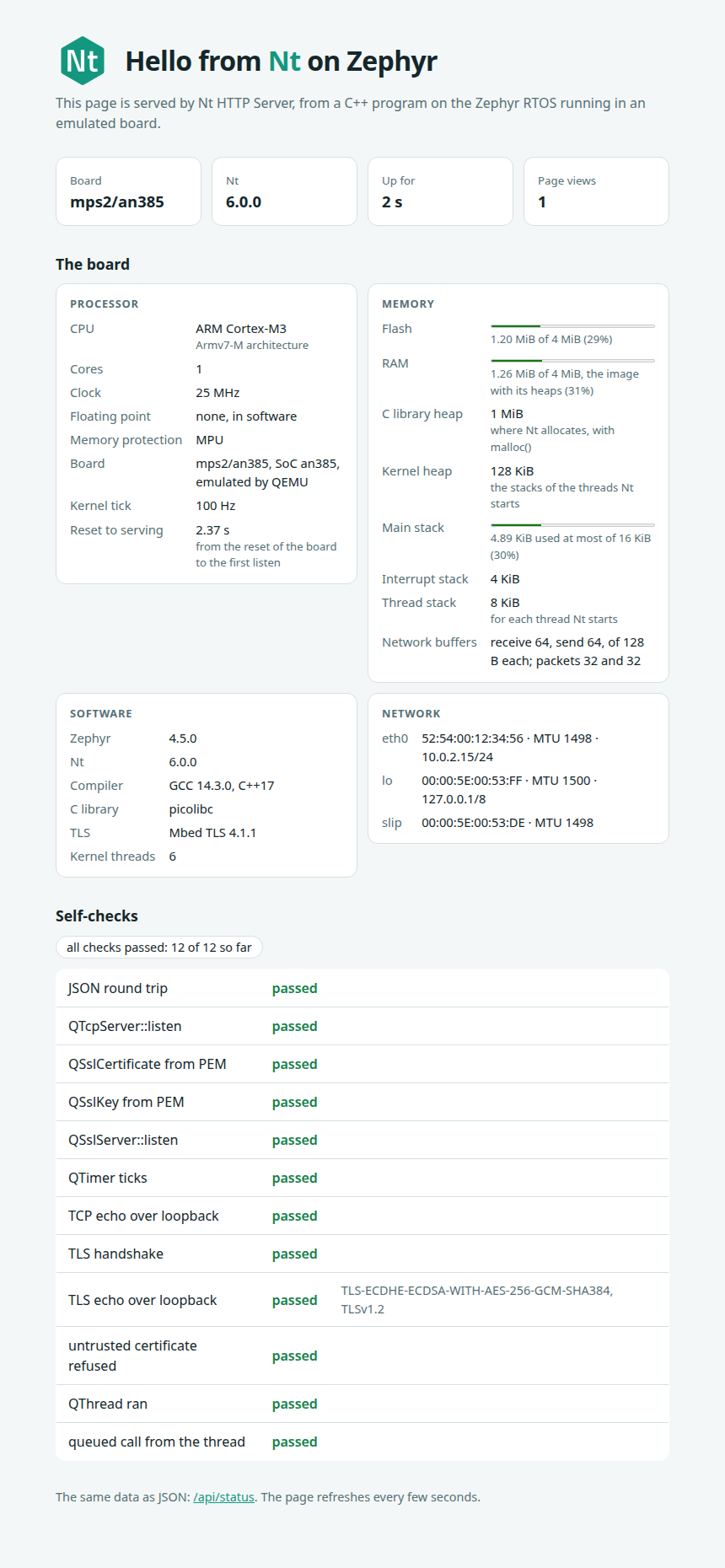
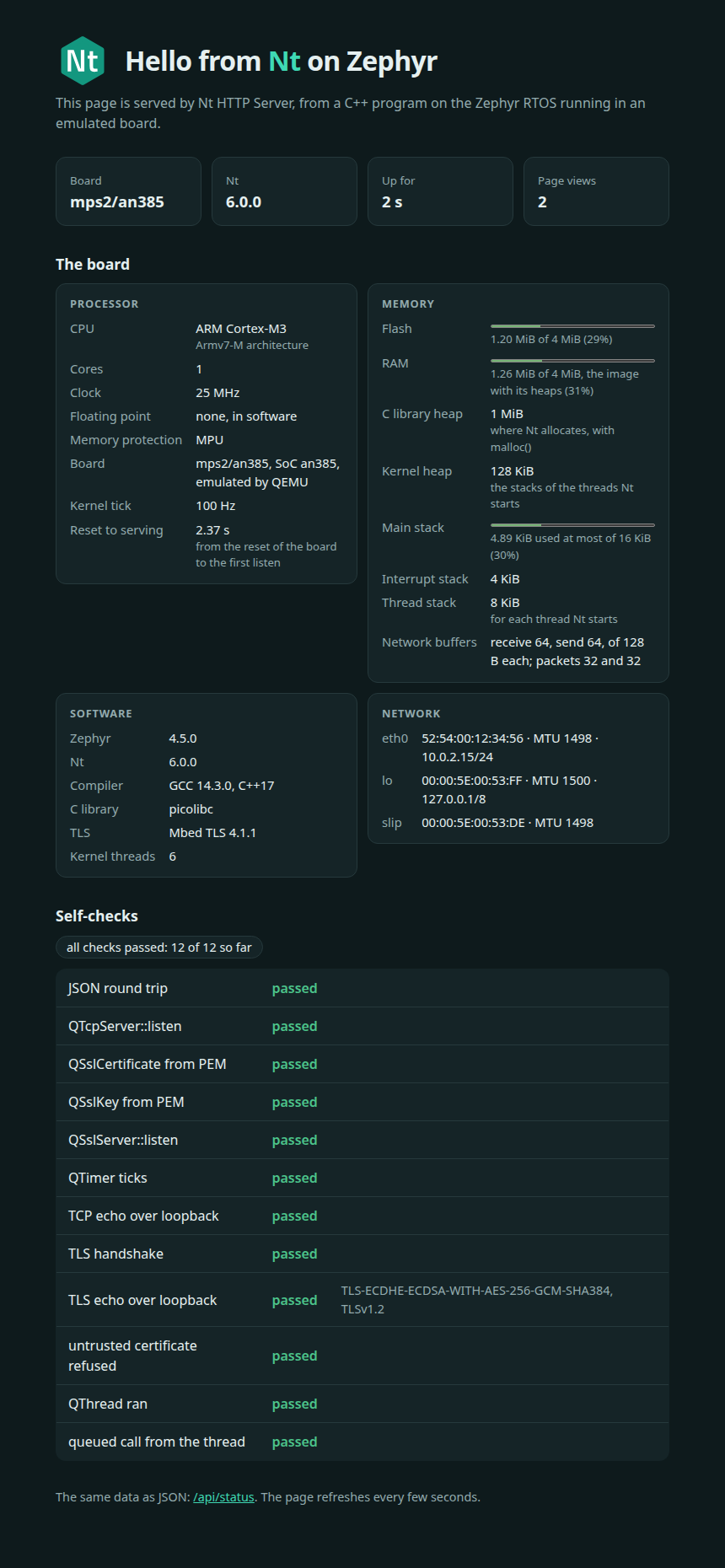
The page also describes the board, as the program finds it out: the processor, the clock, the flash and RAM with how much of each is used, the heaps and stacks, the network buffers, the versions of the software, and the network interfaces, which it lists with QNetworkInterface. The same facts are in the hardware object of /api/status. The sample sets CONFIG_INIT_STACKS so that it can report how much of the main stack was ever used.
Boot Time
From the reset of the emulated board to the first page takes about 2.6 s on a desktop, and the page itself reports the board's own figure, 2.37 s, as "Reset to serving". Of that, 2.1 s are sleeps in Zephyr's driver for the LAN9118: 100 ms to reset the PHY and 2000 ms that its source calls compulsory. The remaining 0.27 s cover the kernel, the drivers, the cryptography and the network stack, Nt's start-up and the listen, and the first request is answered about 60 ms after that. A board with another Ethernet controller starts without those sleeps. The times are those of the emulated processor on one machine, not of real hardware.
The code is in examples/zephyr/qemu/src/webpage.cpp: four routes on a QHttpServer, bound to a QTcpServer, with the page built from a string. It shows the Nt logo, which the server sends from /logo.svg unchanged and the page also uses as its icon. The checks stay in the sample's main.cpp and report to the page with recordResult().
Configuration
CONFIG_NT selects what Nt needs from Zephyr: the full C++ standard library, exceptions, run-time type information, the POSIX API with eventfd and the file system calls, thread local storage and dynamically created threads. CONFIG_NT_NETWORK needs CONFIG_NETWORKING and CONFIG_NET_SOCKETS.
The event loop of a thread waits for all of its sockets in one poll() if it can. Zephyr's poll() fails when it has to wait for more events than CONFIG_ZVFS_POLL_MAX, and counts one event for reading and another for writing on a connected TCP socket, plus one for the descriptor that wakes the loop up. Its default of 3 is used up by a single connection, so Nt raises it to 16. Any limit of 3 or more works: if the sockets of a thread need more events than that, the loop polls them in groups, each with the wake-up descriptor, taking a few milliseconds per group to notice a socket in another group, and the sample for QEMU passes with the limit at 3. A higher limit gives lower latency with many sockets, at the price of that many events on the stack of the polling thread. CONFIG_ZVFS_OPEN_MAX bounds the open descriptors of the whole application, and CONFIG_NET_MAX_CONTEXTS and CONFIG_NET_MAX_CONN the sockets of the network stack.
Host Tools
ntmoc and ntrcc run on the build machine while the libraries are built. A cross build compiles them with the native compiler as CMake configures the project, into nt-host-tools under the build directory. Set NT_HOST_CXX_COMPILER to choose that compiler, or NT_HOST_TOOLS_DIR to use tools that are built already. These tools are built without zlib and Zstandard, so resources are stored uncompressed.
TLS
CONFIG_NT_TLS builds QSslSocket, QSslServer, QSslCertificate, QSslKey and QSslConfiguration, and https: in QNetworkAccessManager, on Mbed TLS 4 and its PSA cryptography, both of which Zephyr provides as a module. It selects TLS 1.2 with the ECDHE ciphers of AES-GCM, X.509 certificates and the reading of keys; add TLS 1.3 and other ciphers with the options of Mbed TLS, for example CONFIG_MBEDTLS_SSL_PROTO_TLS1_3.
QSslConfiguration configuration;
configuration.setCaCertificates(QSslCertificate::fromData(pem));   // the certificates to trust
QSslSocket socket;
socket.setSslConfiguration(configuration);
socket.connectToHostEncrypted(QString("example.com"), 443);
The sample for QEMU runs a TLS server and client against each other over the loopback interface, and checks that a client that trusts no certificate refuses the server.
Trust. Zephyr has no store of certificate authorities, so the certificates to trust have to be named with QSslConfiguration::setCaCertificates() or addCaCertificate(), for example from flash or a resource. Without any, a client verifies nothing and so refuses every server.
Time. Mbed TLS checks the validity dates of a certificate only with
CONFIG_MBEDTLS_HAVE_TIME_DATE, and then against the time of day, which a board without a battery-backed clock has to be given first, for example from SNTP.Randomness. The cryptography draws on the entropy driver of the board; the sample uses
CONFIG_TEST_RANDOM_GENERATOR, which is predictable and must not be used in a product.Memory. Mbed TLS keeps a connection's keys and buffers in the heap of the C library, in addition to the sizes in
CONFIG_MBEDTLS_SSL_IN_CONTENT_LENandCONFIG_MBEDTLS_SSL_OUT_CONTENT_LEN, which can be lowered when the peers use small records.Speed. A handshake computes elliptic curves, which takes noticeable time on a core with no help from hardware, a few seconds for the sample under QEMU on a desktop, so the sample gives QSslServer::setHandshakeTimeout() a generous time.
Drivers. With
CONFIG_MBEDTLS_PSA_P256M_DRIVER_ENABLEDthe handshake of the sample failed with the errorHW_ACCEL_FAILED, so leave it off unless you test it.
Memory
Nt allocates from the heap of the C library, whose size is CONFIG_COMMON_LIBC_MALLOC_ARENA_SIZE. The event loop of the application runs on the main thread, so CONFIG_MAIN_STACK_SIZE has to hold it. The stack of every thread that Nt starts has CONFIG_NT_THREAD_STACK_SIZE bytes, unless QThread::setStackSize() asked for another size, and is allocated from the kernel heap, CONFIG_HEAP_MEM_POOL_SIZE.
What Is Left Out
Zephyr has one process, no shared libraries and no desktop, so these classes are not built. The macro beside each is defined for code that includes the headers of Nt:
QProcess (
QT_NO_PROCESS)QLibrary (
QT_NO_LIBRARY)QSharedMemory (
QT_NO_SHAREDMEMORY) and QSystemSemaphore (QT_NO_SYSTEMSEMAPHORE)QFileSystemWatcher (
QT_NO_FILESYSTEMWATCHER)QStorageInfo (
QT_NO_STORAGEINFO)QLocalSocket (
QT_NO_LOCALSOCKET) and QLocalServer (QT_NO_LOCALSERVER)QSslSocket and
https: (QT_NO_SSL), unlessCONFIG_NT_TLSis setNt HTTP Server and Nt WebSockets, unless
CONFIG_NT_HTTPSERVERis set; they serve on TCP and, with TLS, QSslServer, but QAbstractHttpServer::bind() takes no QLocalServer there
Differences on Zephyr
Threads. The C++ library of the Zephyr SDK is built without thread support. Nt supplies
std::mutex,std::condition_variableand their relatives on the kernel'sk_mutexandk_condvar, in a header that the build includes ahead of every source file that uses Nt. That library still counts the references of astd::shared_ptrwithout atomic operations and keeps one exception state for all threads. A QThread that talks to the rest of the application with queued signals works in the sample for QEMU, but sharing such objects between threads is not safe yet, so keep to one thread where you can.Files. A path has to be absolute and start at a mounted file system: there is no working directory. There are no symbolic links, users or permissions, so a file that exists is readable, writable and owned by user 0. The locations of QStandardPaths are those of a desktop and do not exist.
Time. Local time is UTC, as the C library has no time zones. The steady clock of the C++ library follows the system clock, so setting the time of day moves the timers that are running.
Network. QNetworkInterface lists the interfaces of the Zephyr network stack, with their addresses, netmasks and hardware address. Host names are resolved with
getaddrinfo(), which needsCONFIG_DNS_RESOLVER.Numbers. Nt writes a number with decimals through
vsnprintf(), and the picolibc of Zephyr prints*float*in its place unless its printf supports floating point.CONFIG_NTselectsCONFIG_REQUIRES_FLOAT_PRINTFfor that, which costs some flash.Randomness. QRandomGenerator::system() reads
getentropy(), which needs an entropy driver on the board.
See also Installing Nt and Thread Support in Nt.